
Friday, May 31, 2013
Wednesday, May 29, 2013
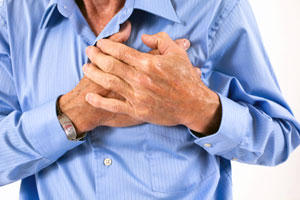
Coenzyme Q10 May Help Patients Fight Heart Failure
 |
| Credit: img2.timeinc.net |
This energy-boosting supplement could
HALVE the number of deaths from heart failure
Regular
doses of the dietary supplement Coenzyme Q10 cut in half the death rate of
patients suffering from advanced heart failure, in a randomized double-blind
trial presented recently at the annual meeting of the Heart Failure Association
of the European Society of Cardiology, in Lisbon, Portugal.
Researchers
also reported a significant decrease in the number of hospitalizations for
heart failure patients being treated with Coenzyme Q10 (CoQ10).
About
14% of patients taking 100 milligrams of CoQ10 three times a day suffered from
a major cardiovascular event that required hospital treatment, compared with
25% of patients receiving placebos.
In
heart failure, the heart becomes weak and can no longer pump enough oxygen- and
nutrient-rich blood throughout the body. Patients often experience fatigue and
breathing problems as the heart enlarges and pumps faster in an effort to meet
the body's needs.
Coenzyme
Q10 occurs naturally in the body. It functions as an electron carrier in
cellular mitochondria (the cell's "powerhouse") to help convert food
to energy. It also is a powerful antioxidant, and has become a popular over-the-counter
dietary supplement.
“CoQ10
levels are decreased in the heart muscle of patients with heart failure, with
the deficiency becoming more pronounced as the severity of their condition
worsens,” said lead researcher Svend Aage Mortensen, a professor with the Heart
Center at Copenhagen University Hospital, in Denmark.
"CoQ10
is the first medication to improve survival in chronic heart failure since ACE
inhibitors and beta blockers more than a decade ago and should be added to
standard heart failure therapy," Professor Mortensen added.
###
The
above story is based on the May 25, 2013 news release by European Society ofCardiology.
While
randomized clinical trails are considered the "gold standard" of
studies, because this new study was presented at a medical meeting, the data
and conclusions should be viewed as preliminary until published in a
peer-reviewed journal.
More information
Visit
the U.S. National Heart, Lung, and Blood Institute to learn more about heart
failure.
Tuesday, May 28, 2013
Fish Oil May Help the Heart Beat Mental Stress

The omega 3 fatty acids in fish oil have long been thought
to protect against cardiovascular disease -- so much so that the American Heart
Association currently recommends eating at least two servings of fish a week,
particularly fatty varieties rich in omega 3s.
However, the mechanism behind this protective effect still
remains a mystery.
In a new study on 67 adult volunteers, scientists led by
Jason R. Carter of Michigan
Technological University
shed light on this phenomenon by providing evidence that fish oil might
specifically counteract the detrimental effects of mental stress on the heart.
Their findings show that volunteers who took fish oil
supplements for several weeks had a blunted response to mental stress in
several measurements of cardiovascular health, including heart rate and muscle
sympathetic nerve activity (MSNA), part of the "fight or flight"
response, compared to volunteers who took olive oil instead.
The results may explain why taking fish oil could be
beneficial to the heart and might eventually help doctors prevent heart disease
in select populations.
###
The above story is based on the May 22, 2013 news release by American
Physiological Society (APS).
The paper has been published in AJP-- Regulatory,
Integrative, and Comparative Physiology, published by the American
Physiological Society:
Carter JR, Schwartz CE, Yang H, Joyner MJ. Fish oil and
neurovascular reactivity to mental stress in humans. Am J Physiol Regul Integr Comp Physiol. 2013; 304 (7): R523 DOI: 10.1152/ajpregu.00031.2013
Saturday, May 25, 2013
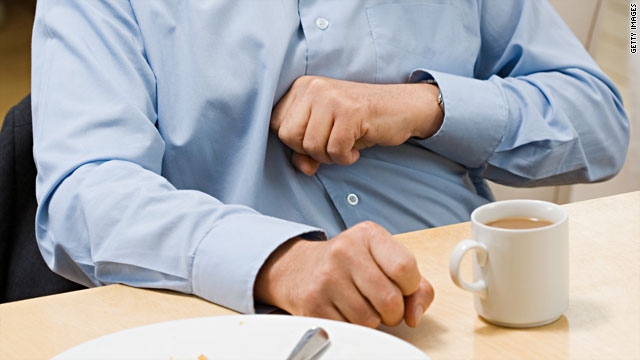
Chronic Heartburn May Raise Odds for Throat Cancer
 |
| Credit: i.cdn.turner.com |
78 percent increase
in the risk for cancer in people who experience heavy heartburn
People who suffer from frequent gastric reflux may be at
increased risk for cancers of the throat and vocal cords even if they don't
smoke or drink alcohol, a new study says.
Stomach acid can reach into the upper airway, inducing
cellular damage in the epithelial lining. This condition is believed to be a
risk factor for development of laryngopharyngeal squamous cell carcinoma
(LPSCC).
But simple antacids
appear to lower the risk
Interestingly, common over-the-counter antacids seemed to
protect against these cancers while prescription medications such as Prilosec,
Nexium and Prevacid didn't, the researchers said.
The researchers led by Scott Langevin of the Brown University
in Providence found
that the protective effect of antacids was independent of smoking, drinking or
infection with HPV*.
While it uncovered an association between heartburn and
cancer of the throat and vocal cords, the study did not prove a
cause-and-effect relationship.
Further studies are needed to clarify this possible chemopreventive
role of antacid.
###
The report was published online May 23, 2013 in the journal
Cancer Epidemiology, Biomarkers & Prevention:
Langevin SM et al. Gastric
Reflux Is an Independent Risk Factor for Laryngopharyngeal Carcinoma. Cancer Epidemiol Biomarkers Prev; 22(6); 1–8.
* Since some head and neck cancers are caused by the human papillomavirus
(HPV), the researchers tested all the participants for antigens to the virus.
Friday, May 24, 2013
Body Fat Hardens Arteries after Middle Age

Having too much body
fat makes arteries become stiff after middle age, a new study has revealed.
In young people, blood vessels appear to be able to
compensate for the effects of obesity. But after middle age, this adaptability
is lost, and arteries become progressively stiffer as body fat rises -
potentially increasing the risk of dying from cardiovascular disease.
The researchers suggest that the harmful effects of body fat
may be related to the total number of years that a person is overweight in
adulthood. Further research is needed to find out when the effects of obesity
lead to irreversible damage to the heart and arteries, they said.
Obesity is known to be a major risk factor for heart
disease, but the reasons for this are not fully understood.
Researchers at the Medical Research Council (MRC) Clinical
Sciences Centre at Imperial College London scanned 200 volunteers to measure
the speed of blood flow in the aorta, the biggest artery in the body. Blood
travels more quickly in stiff vessels than in healthy elastic vessels, so this
allowed them to work out how stiff the walls of the aorta were using an MRI
scanner.
Certain metabolic products in the blood may progressively
damage the elastic fibres in our blood vessels. Understanding these processes
might help us to prevent the harmful effects of obesity.
###
The above story is based on the Wednesday 15 May 2013 news
release by Imperial
College London.
The research has been published
online in Hypertension, the scientific
journal of the American Heart Association:
Corden B, Keenan NG, de Marvao ASM, Dawes TJW, DeCesare A, Diamond
T, Durighel G, Hughes AD, Cook SA, O'Regan DP. Body Fat Is Associated With Reduced Aortic Stiffness Until Middle Age.
Hypertension, 2013; DOI: 10.1161/HYPERTENSIONAHA.113.01177
The Omron HBF-306C measures body fat with a micro electrical
current.
Muscles, blood vessels and bones are body tissues having a
high water content that conduct electricity easily. Body fat is tissue that has
little electric conductivity. The Body Fat Analyzer sends an extremely weak
electrical current of 50 kHz and 500 µA through your body to determine the
amount of fat tissue. This weak electrical current is not felt while operating
the Body Fat Analyzer. The Bioelectrical Impedance Method safely combines the
electric resistance with the distance of the electricity conducted. Correct
posture and consistent measuring conditions need to be maintained for the best
results.
The Omron HBF-306C retails at RM380.00 per unit
If sex with 3 people is called a threesome.....

.......and sex with 2 people is a twosome,
now I understand why they call you handsome!
Here's some more corny jokes to lighten up your weekend:
CONDOM
Condoms
don’t guarantee safe sex anymore …..
A friend of mine was
wearing one when he was shot by the woman’s husband.
NEW
BOOK
A religious
police walks into Borders at Berjaya Times Square, Kuala Lumpur and asks the
young lady assistant,
"Do you have the new book out for men with short
penises?"
She
replies, "I'm not sure if it's in yet."
"That's
the one; I'll take a copy…"
PREGNANT
PROSTITUTE
Doctor
asks pregnant prostitute, "do you know who the father is?"
"For
goodness’ sake, if you ate a tin of beans would you know which one made you fart?
Thursday, May 16, 2013
The Scientific 7-minute Workout - Skim Cepat Kerus?

Maximum Results With Minimal
Investment in Time and Money
This is a workout video based on
the workout published in the American
College of Sports
Medicine.
The program by Brett Klika and
Chris Jordan features twelve 30-second exercises that alternates from ones that
emphasizes the large muscles in the upper body with those in the lower body
with 10 second breaks between exercises.
This aerobic and resistance
routine takes only 7 minutes and all you need is your body, a wall, and a
chair.
The 7-minute workout offers many
of the fitness benefits of prolonged endurance training but in much less time.
###
The research has been published in ACSM's Health & Fitness Journal,
an official publication from the American
College of Sports
Medicine (ACSM):
Klika
BK, Jordan C. High-Intensity Circuit
Training Using Body Weight: Maximum results with minimal investment.ACSMS
Health Fit J. May/June 2013; 17(3): 8–13.doi:
10.1249/FIT.0b013e31828cb1e8
Need
further convincing? Click HERE for the full text.
You can exercise along with this video guide:
Click HERE if the video does not appear on
your screen
Tuesday, May 14, 2013
Go On, Suck On Your Baby’s Pacifier!
 |
| Credit: www.legacy-cdn.smosh.com |
Parents
Who Suck On Their Infants' Pacifiers May Protect Their Children Against
Developing Allergy
Allergies
are very common in industrialized countries. It has been suggested that
exposure to harmless bacteria during infancy may be protective against the
development of allergy.
However,
it has been difficult to pinpoint which bacteria a baby should be exposed to,
and at what time and by which route this exposure should ideally occur.
Swedish
researchers at the Sahlgrenska Academy, University of Gothenburg, found that
children whose parents habitually sucked the pacifier were three times less
likely to suffer from eczema at 1.5 years of age, as compared with the children
of parents who did not do this.
Saliva is
a very rich source of bacteria and viruses, and the researchers believe that
oral commensal microbes are transferred from parent to infant when they suck on
the same pacifier. When the composition of the bacterial flora in the mouth was
compared between infants whose parents sucked on their pacifiers and those
whose parent did not, it was found to differ, supporting this hypothesis.
According
to "the hygiene hypothesis," the development of allergy can be
attributed in part to a paucity of microbial stimulation during early infancy.
"Early
establishment of a complex oral microflora might promote healthy maturation of
the immune system, thereby counteracting allergy development," says
professor Agnes Wold who led the study.
###
The above
story is based on the May 6, 2013 news release by University of Gothenburg,
Sweden.
The
research has been published online May 6, 2013 in Pediatrics, the official
journal of the American Academy of Pediatrics:
Hesselmar
B, Sjoberg F, Saalman R, Aberg N, Adlerberth I,
Wold AE. Pacifier Cleaning
Practices and Risk of Allergy Development. PEDIATRICS, 2013; DOI: 10.1542/peds.2012-3345
Click HERE for the Full Text to fully convince yourself ;-)