Wednesday, May 11, 2011

Caregivers, Don't Ignore Your Own Health

Picture credit: www.careforyourelderblog.com

Suggestions to help you stay well

Caring for someone else during a serious illness can take a lot out of you. The American Academy of Family Physicians says it's important to take care of yourself as you care for someone else.

The academy offers these suggestions:

- Get regular checkups with your own doctor.

- Eat a healthy, nutritious and balanced diet.

- Find time for plenty of sleep.

- Schedule time for 30 minutes to 60 minutes of exercise at least four days per week.

- Help manage stress with techniques such as meditation or deep breathing exercises.

- Take some time for yourself every once in a while.

Tuesday, May 10, 2011

Lionel Rose dies aged 62


Photo Credit: Justin McManus

It is with deep regret that we announce the sad demise of Lionel Rose, the first Aboriginal Australian boxer to win a world title, on May 8, 2011
The Australian Associated Press reported that Rose, who beat Japan's Fighting Harada in Tokyo in 1968 to win the world bantamweight title, had been ill for several months.
He finished his professional career after 53 fights with 42 wins, 12 of them by knock-out.
Rose was named as Australian of the year in 1968 after his world title win, the first Aborigine to receive the honour.
He also was appointed a Member of the Order of the British Empire (MBE) in the same year.
Another fellow boxer, Jeff Fenech, paid tribute to his close friend after being told the news.
"Lionel was not only a great fighter but a wonderful human being," Fenech told News Limited.
"He was an absolute legend and I was honoured to know him as a friend."
News of Rose's death comes on a significant day for Australian boxing, with Daniel Geale earlier becoming only the fourth Australian to win a world title overseas after his defeat of German champion Sebastian Sylvester for the IBF middleweight title.
Geale joins Rose, Jeff Harding and Jimmy Carruthers as the only Australians to achieve the feat.
Rose also enjoyed some success as a recording artist, having two hits with "I Thank You" (yes, we have downloaded this song for your listening pleasure, click HERE) and "Remember Me".
He suffered a stroke in 2007 that had left him partially paralysed and with speech difficulties.
Lionel was honoured with a 3.6 metre, larger-than-life bronze statue at his hometown and birthplace, Warragul, on June 2, 2010, see our report.
I was not fortunate to have met Lionel in person but I was with the bronze fella in Warragul last December with my dad, Hoe.
Rest in Peace Lionel, you will be missed by many.
PS. Noticed the beautiful weather? That was a respite in an otherwise gloomy day. Strange but the rain actually stopped briefly for this shoot.
Click here for Sydney Morning Herald's "Lionel Rose in black and white"

Sunday, May 8, 2011

Lack of Sleep Linked to Childhood Obesity

Picture credit: www.fitnesshealthgym.com


The obesity pandemic is claiming its presence even among youngest of children and is clearly on the rise. The potential interrelationships between sleep and obesity have gained recent attention.

A new study published in Pediatrics, the Journal of the American Academy of Pediatrics, said young children who skimp on sleep both during the week and on the weekends may be at an increased risk of becoming obese.

According to lead researcher Dr. David Gozal of the University of Chicago in Illinois, children who sleep the least could be four times more likely to develop an unhealthy body weight.

"If a child has a tendency to be obese but gets adequate sleep, he is more likely to be protected than if he is not sleeping as much as he needs. Catch-up sleep is better than nothing and can help, but we don't think it can offer complete protection."

For the study, researchers used a special sleep monitoring bracelet on 308 children in Louisville, Kentucky.

Before the study the young subjects were identified as normal, overweight, or obese based on their body mass index (BMI) scores, a measure of body fat based on height and weight. They followed the group, which ranged in ages from 4 to 10 years old, for one week.

Children slept 8 hours per night, on average, regardless of their weight categorization. A nonlinear trend between sleep and weight emerged.

For obese children, sleep duration was shorter and showed more variability on weekends, compared with school days. For overweight children, a mixed sleep pattern emerged.

Fasting morning plasma levels of glucose, insulin, lipids, and high-sensitivity C-reactive protein also were measured for a subsample. Obese children whose shorter sleep duration and more-variable sleep wake timing had the unhealthiest blood profiles.

Parents, and doting grandparents, here’s enough reason to enforce your little one's bed times or risk obesity and metabolic dysfunction.

BMI for children and teens? Click here to find out how BMI is calculated and interpreted.

Journal Reference:
Karen Spruyt, Dennis L. Molfese, and David Gozal. Sleep Duration, Sleep Regularity, Body Weight, and Metabolic Homeostasis in School-aged Children. Pediatrics 2011; 127: e345-e352. Click here to download the full paper.

The researchers believe that lack sleep contributes to obesity by wreaking havoc on metabolism and the endocrine system -- and this is especially true when the body is young and still growing. Dr Gozal said there are numerous studies where sleep deprivation has been shown to disrupt levels of gherlin and leptin, two hormones which regulate hunger and appetite. When the body craves sleep, it interprets it as hunger causing leptin levels to crash and ghrelin levels to spike; this in turn, seems to trigger overeating and may also signal the body to cling to fat stores more tenaciously.

Other studies indicate that poor sleep can throw off the body's biological clocks -- also known as circadian rhythms -- particularly the clock that regulates glucose and insulin, two hormones that when out of balance, are closely associated with weight gain, heart disease and diabetes. Sleep deficit has also been found to elevate levels of cortisol, a hormone that among other things regulates how the body uses energy; elevated cortisol levels have been linked to insulin resistance and a higher BMI.

Cut Back on Preschoolers' Fat

x

It's not too early to watch their diet

Babies and young toddlers need a good dose of fat and calories to help them grow and develop properly. But by the time they are ready for preschool, it's time to start watching what youngsters eat.

The American Academy of Pediatrics (AAP) offers these recommendations to limit fat in your preschooler's diet: Instead of whole milk, offer your child skim or 2 percent milk.

  • Make sure your child's meats are lean cuts, and are grilled or broiled.
  • Serve your child modest portions of cheese.
  • Cut back on your child's consumption of fruit juice; instead offer whole fruits.
  • Offer low-fat snacks, such as fat-free yogurt, fresh fruit, air-popped popcorn and pretzels.
  • Prepare food with lower-fat cooking methods, such as roasting, broiling or steaming with non-fat cooking spray, or a bit of olive oil.
Click here for the AAP Web site dedicated to the

PREVENTION AND TREATMENT OF

Childhood Overweight and Obesity

The AAP hopes to bring awareness to the serious health problem of childhood overweight and obesity; empower pediatricians and families to take action in their homes, offices and communities to prevent childhood obesity; and to support pediatricians, families and community advocates in improving the health status of those children who are already overweight and obese.


Saturday, May 7, 2011

Obese people less sexually satisfied


Picture credit: www.thebodydiaries.com

Weighing too much may increase your risk for developing many health problems (1). Being overweight or obese (2), puts you at risk for many of obesity's health effects. These include:

Type 2 diabetes

Heart disease

Stroke

High blood pressure (hypertension)

High cholesterol (hypercholesterolemia)

Certain cancers

Sleep apnoea

Osteoarthritis

Gallbladder disease and gallstones

Fatty liver disease (also called nonalcoholic steatohepatitis or NASH)

Gastroesophageal reflux disease (GERD)

Gout

Decreased longevity

Psychological and emotional effects.

even an increased risk of buying two plane tickets for one person

......
and now let's ADD decreased sexual satisfaction!

Being fat can dampen your sex life, a new study suggests.

Duke University researchers studied 91 obese men and 134 obese women with a body mass index (BMI) of at least 30 who completed a sexual functioning questionnaire before enrolling in a weight loss study. The questionnaire covered nine areas: interest, desire, arousal, orgasm, satisfaction, behavior, relationship, masturbation and sexual problems.

"We found that there was lower sexual satisfaction and lower sexual quality of life among women than men, and overall sexual quality of life was low among both groups," Dr. Truls Ostbye, a professor in the department of community and family medicine, said in a Duke news release.

The researchers also compared the obese patients' scores to the results from a group of cancer survivors and a general population group. Obese women's scores were lower than both those groups' scores, while obese men's scores were between the scores of the cancer survivors and the general population group.

"Our findings contribute to a growing body of research that indicates obesity is associated with reduced sexual functioning and sexual quality of life among both men and women," Ostbye said.

Doctors should be aware of this issue and invite obese patients to talk about it, the researchers said.


1. Kopelman PG, Grace C. New thoughts on managing obesity. Gut. 2004 Jul;53(7):1044-53. Click here for more facts.

2. Obesity is defined as a body mass index (BMI) of 30 kg/m2 or more, where a person’s BMI is defined as their weight in kg divided by the square of their height in metres. Overweight is defined as a BMI between 25 and 29.9 kg/m2.

3. Ostbye T, Kolotkin RL, He H, Overcash F, Brouwer R, Binks M, Syrjala KL, Gadde KM. Sexual functioning in obese adults enrolling in a weight loss study. J Sex Marital Ther. 2011 May;37(3):224-35.


Mission Impossible?
No!
Click here for the many ways YOU can make it happen.

Zestz for LAUGHS - Where's the f*ckin' ship?

Picture credit: www.farm1.static.flickr.com


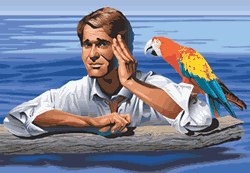
A magician worked on a cruise ship.

The audience was different each week so the magician did the same tricks over and over again.

There was only one problem: The captain's parrot saw the shows each week and began to understand how the magician did every trick.

Once he understood, he started shouting in the middle of the show, "Look, Its not the same hat!" or, "Look, he's hiding the flowers under
the table!" Or "Hey, why are all the cards the ace of spades?"

The magician was furious but couldn't do anything. It was, after all, the captain's parrot.

Then one stormy night on the Pacific, the ship sank, drowning almost all who were on board.
The magician luckily found himself on a piece of wood floating in the middle of the sea, as fate would have it ... With the parrot.

They stared at each other with hatred, but did not utter a word.

This went on for a day... And then 2 days. And then 3 days. Finally on the 4th day, the parrot could not hold back any longer and said...

"OK, I give up. Where's the f*ckin' ship?


Recommended by John KH with explitive toned down for general consumption, original author unknown.

After You Run a Marathon

Picture Credit: www.away-together.com


Running 40 kilometers or more can take a major toll on your body, so it's important to take it easy after you've finished a marathon.

The Cleveland Clinic suggests what to do after you cross the finish line:

  • Continue drinking plenty of water.
  • Eat or drink carbohydrates to replenish what you've used. But don't overdo it, or you may get an upset stomach.
  • Stretch gently and walk for about an hour after the race to help minimize stiffness.
  • Ice any sore areas in 15-minute intervals throughout the rest of the day.
  • Treat yourself to a post-race massage.
  • The week after the marathon, don't run. Walk, bike or swim if you want to exercise.
  • Ease back into running, gradually increasing your distance and speed over time. Don't focus on speed for the first month or strength training for the first two weeks after the race.
  • Take time to rest, recover and heal

Cleveland Clinic is a non-profit academic medical center that integrates clinical and hospital care with research and education.Link