Tuesday, May 17, 2011

Do It Non-Orally!

Picture credit: http://i.livescience.com


Sizzling Non-Oral Sex Tips From France

We know what the French are really good at. Even though there are over 600 positions a couple can try in bed, the reality is that many of them require the agility, stamina and balance of professional athletes!

The good news, according to Eve Marx, is that two classic sex positions culled from the French require no special skills or athletic talent. Try them and see if they improve l’amour.!

The Flanquette Position, CLICK HERE for graphic which we are too shy to publish, asks partners to arrange themselves on the bed so that the woman lies on her side, facing her man with one of her legs between his; at the same time, one of his legs is between hers. This face to face position encourages kissing, nuzzling, and a lot of physical contact above the waist. Below the waist, however, there are also special benefits. Specifically extra pressure is directed on the woman’s clitoris because the man’s thigh is pressing against it. Maximal clitoral pleasure is from a recumbent posture is the advantage here; the Flanquette more is definitely a woman-pleasing position. Insertion and penetration isn’t even required if neither partner desires it. By the way, the French call any sexual friction activity that doesn’t include insertion of the penis, “frottage.”

The Cuissade Position, CLICK HERE, aw schucks, refers to any half-rear, half-side entry. And by “entry,” this includes penetration. In English, the word sounds a lot like the word “Cuisinart”! Cuissade is a low-impact, lazy position, best for long, leisurely, directionless lovemaking. This makes it ideal for couples who want the woman to be able to have a series of multiple orgasms, or for a man who can hold back from ejaculation for a very long time (or is not focused on ejaculation). Try this position on vacation or any time you’ve got plenty of time. How to do it? The man lies behind the woman in the spoon position where they are both lying on their sides. She must lift her leg or even rest her thigh on his. Slow thrusting is the way to do it. And don’t forget to breathe!

Good Luck, Have Fun....responsibly!

Happy Birthday Buddha*

As millions of people worldwide observe the 2,600 anniversary of Buddha’s enlightenment, United Nations (UN) Secretary-General Ban Ki-moon paid tribute to the spiritual leader’s teaching on the need for compassion and solidarity with those less fortunate.

Addressing the General Assembly today (16 May), Ban said that “Buddhism and the United Nations share the goals of peace, dignity and human rights for all people” adding that that is why, more than ten years ago, the General Assembly passed a resolution on recognizing Vesak Day.

The Secretary-General said that Buddha’s teachings “may be twenty-six centuries old, but they are as powerful as ever today.” He called on everyone to remember Buddha’s message of tolerance and respect for all religions.

* Vesak Day marks the birth, enlightenment and passing of the Buddha.

Green Tea and Tai Chi Enhance Bone Health and Reduce Inflammation in Postmenopausal Women

Picture credit : www.diseaseproof.com

The potential for green tea to work synergistically with tai chi in enhancing bone strength has been examined in a group of postmenopausal women. The results show that consumption of GTP and participation in tai chi independently enhanced markers of bone health.

Green tea is chock full of compounds called polyphenols known for their potent antioxidant activity. Dozens of epidemiological (observational) studies have shown that people who consume the highest levels of green tea polyphenols (GTP) tend to have lower risks of several chronic degenerative diseases such as cardiovascular disease and osteoporosis. These findings suggest that the mechanism behind this correlation may have to do with lowering chronic levels of inflammation.

In a recent research, Dr. Chwan-Li Shen of Texas Tech University and colleagues1 focused on postmenopausal women and investigated the potential for green tea to work synergistically with tai chi -- a traditional Chinese form of moderately intense aerobic fitness activity grounded in mind-body philosophy -- in enhancing bone strength.

Carried out as a double-blind, placebo-controlled, intervention trial (the "holy grail" of scientific studies), this experiment involved 171 postmenopausal women (mean age: ~57 y) who had weak bones but not full-fledged osteoporosis.

Subjects were divided into 4 groups:

- Placebo: starch pill (placebo) and no tai chi
- GTP: green tea polyphenols (500 mg/day)2 and no tai chi

- Placebo+TC: starch pill and tai chi (3 times/week)

- GTP+TC: green tea polyphenols and tai chi

The study lasted for 6 months, during which time blood and urine samples were collected and muscle strength assessed.

The results show that consumption of GTP (at a level equivalent to about 4-6 cups of steeped green tea daily) and participation in tai chi independently enhanced markers of bone health by 3 and 6 months, respectively. A similar effect was found for muscle strength at the 6-month time point. Participants taking tai chi classes also reported significant beneficial effects in quality of life in terms of improving their emotional and mental health. Perhaps most remarkable, however, was the substantial effect that both GTP and tai chi had on biological markers of oxidative stress. Because oxidative stress is a main precursor to inflammation, this finding suggests that green tea and tai chi may help reduce the underlying etiology of not only osteoporosis, but other inflammatory diseases as well.

Dr. Shen and colleagues concluded that there is a "favorable effect of modest green tea consumption on bone remodeling in this pre-osteoporotic population" and hope to soon complete a more long-term study utilizing more technically savvy measures of bone density.

(1) Green Tea, Tai Chi Enhance Bone Health, Reduce Inflammation in Postmenopausal Women, co-authored by Shen C, Chyu M, Yeh JK, Zhang Y, Pence B, Felton C, Brismee J, Dagda R, Doctolero S, Flores M, Wang J was presented as a poster at the Experimental Biology meetings on April 10, 2011.

(2) 500mg of GTP: green tea polyphenols is equivalent to about 4-6 cups of steeped green tea


Tai Chi For Beginners

The Tai Chi group that meets Tuesdays and Fridays at Hin Hua High School, Persiaran Raja Muda Musa, Klang welcomes beginners. Bilingual classes start at 8.30pm under the direction of Messrs Aw and Ng. No 'pyjamas' required; come in your most comfortable apparel .You can call our pharmacy on 03 31688469 for further details.

Saturday, May 14, 2011

Why Deprivation Doesn’t Work–And What Does

At some point in your life you’ve probably tried dieting, saving, quiting a bad habit, or stopping negative thoughts by using the “deprivation” approach. In other words, the “just say no” approach. If you’re like most people, this may have worked for a short while and then backfired. You may have rebounded to feel an even stronger urge to do what you tried not to do—be it eating junk food, spending excessively, smoking, or negative self-talk.

Deprivation is what you might call a “resistant strategy.” As noted above, it is based on saying “no” to something. What happens with saying no is that you are still associating with whatever you are saying no to. The behavior you are resisting is still just as much a part of your thinking, feeling, and action—just in a negative sense. When you resist something, it persists in your field of awareness. You keep it alive by fighting against it. You are still caught in the same chain of association, just on the other side of the equation.

If you really want something to go away, don’t focus on it positively or negatively. Instead, pay attention to something else.

This brings us to a different strategy—substitution. Substitution takes advantage of the power of association in a different way. It takes an existing pattern of thought, feeling, and behavior and shifts it. Rather than focusing on saying “no” to something, you say “yes” to something else. When you are triggered in a way that usually elicits a certain thought, feeling, or behavior, you consciously pair that with a new thought, feeling, or behavior. If you repeat that new association enough times and it has enough positive emotion associated with it, it will become your new response pattern in that situation.

For example, if you want to let go of excess weight and find yourself triggered to eat fast food whenever you pass by it on your way to work, find a new route that passes by an awesome place to get tea. Order the absolute best tea they have, something that tastes really good, that you really enjoy, and make that your new habit.

If tea doesn’t do it for you because you really want to chew something, maybe you can find the greatest tasting, xylitol sweetened gum and substitute that. Or maybe a crisp, sweet, organic apple will do it for you.

The secret is to find an attractive substitute that creates the effect you want in your life. Find something positive and enjoyable to say “yes” to, instead of trying to enforce a “no.” Here are some other suggestions to spur your own creativity.

If you want to stimulate your mind and inspire your soul, record your favorite TV show, fast forward through the commercials and use the extra time to read something that fascinates you. You’ve just substituted inspiring reading for watching commercials.

If you know you need to exercise, but can’t stand sitting or standing on a cardio-machine or lifting weights, substitute taking a hike with a friend in a beautiful environment.

If you can’t seem to get to sleep at night, instead of spending time tossing and turning, try substituting meditation during your “falling asleep time.” Meditation will shift you from your busy-mind, beta brainwaves down a notch to slower alpha brainwaves, which will lead you closer to a sleep state. It will also enable your mind to let go of the events of the day, so that, when you do sleep, it is more restful.

If you have a behavior you’d like to let go of, find a positive substitute that you look forward to and put that in its place.

By Kevin Schoeninger of The Mind-Body Training Company

Kevin also talks about using substitution with negative feelings, thoughts, and beliefs. Check out “Secrets of Meditation” to learn more.

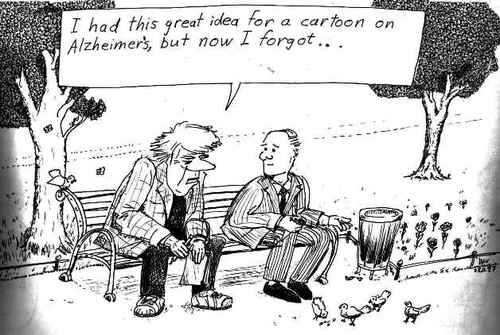
Uric Acid And Dementia

Picture credit: www.toonpool.com

Elevated Uric Acid Level May Forewarn Dementia Risks

Normal values for uric acid fall between 3.0 and 7.0 mg/dL.(1)

A high uric acid (UA) level may not cause problems. However, some people develop gout, kidney stones or kidney failure due to high uric acid levels. A high uric acid level may appear prior to the development of high blood pressure, heart disease or chronic kidney disease. But it's often unclear whether a high uric acid level is a direct cause or merely an early warning sign of these conditions.

A recent study (2) of 1,061 persons over 60 years of age (593 women and 468 men) suggests a positive association between high circulating levels of UA and dementia syndome which, at least in part, is independent of most cardiovascular, cerebrovascular and metabolic risk factors.

The authors, from the Institute of Gerontology and Geriatrics, University of Perugia, Italy defined hyperuricemia as UA level of greater than 7.5 mg/dl in men and greater than 6.2 mg/dl in women. For statistical analysis, UA was divided into tertiles (3) according to the following cut-points: 4.6 and 5.6 mg/dl.

Persons with circulating UA levels in the highest tertile showed a threefold higher probability of being affected by a dementia syndrome. The probability of having dementia remained significantly higher independent of several confounders such as age, sex, education, BMI, smoking habit, total energy and alcohol consumption, vitamin E and cholesterol plasma levels, hypertension, renal function, cardiovascular and cerebrovascular diseases.

Persons with UA levels within the middle UA tertile showed a clear tendency to be affected by a dementia syndrome with about twofold higher probability.

The authors suggest that it would be worthwhile to perform clinical trials aimed at determining whether the pharmacological reduction in UA levels prevents the onset or delays the progression of dementia.

(1) Normal uric acid values may vary slightly from laboratory to laboratory. Click here for more on uric acid.

(2) Ruggiero C, Antonio Cherubini A, Lauretani F,Stefania Bandinelli S, Maggio M, Di Iorio A, Zuliani G, Dragonas C, Senin U, Ferruccih L. Uric Acid and Dementia in Community-Dwelling Older Persons. Dementia and Geriatric Cognitive Disorders. 2009 April; 27(4): 382–389. doi: 10.1159/000210040. Click here for the complete paper.

(3) A tertile is any of the two points that divide an ordered distribution into three parts, each containing a third of the values. Normal values for uric acid falling between 3.0 and 7.0 mg/dL., thus the cut-points of 4.6 and 5.6 mg/dl.

Why wait, you should take steps to reduce you UA level if it is on the high side.

Here’s What You Can Do To Control Your Uric Acid Levels.

Maintain a healthy, balanced diet.

Adjust your diet to prevent the onset of hyperuricemia. Avoid large amounts of foods containing a moderate concentration of purine, since they increase the amount of uric acid in the body and may trigger a gout attack. Low fructose intake is important as well. Click here for more on dieting.

Exercise regularly.

Develop a regular exercise routine. Try moderate-intensity exercise for at least 30 minutes most days of the week. Types of suggested exercise include:

  • Walking briskly
  • Mowing the lawn
  • Dancing
  • Swimming
  • Bicycling on level terrain

Be careful about strenuous exercise, since it may raise uric acid levels.

Work with your physician to develop an appropriate exercise program tailored to your body, lifestyle and needs. Always check with your physician before starting an exercise program.

Maintain a healthy body weight.

Increasing the intensity or the amount of time you are physically active is also beneficial to prevent weight gain. Obesity contributes to many chronic conditions, including hyperuricemia. Excess weight affects how the body metabolizes nutrients and waste products. Avoid rapid-weight loss diets and low-carbohydrate diets high in protein and fat, both of which can elevate uric acid levels.

Obesity is defined as a body mass index (BMI) of 30 or higher. Click here to calculate your BMI.

Stay hydrated.

Water is vital for transporting nutrients throughout the body and eliminating waste. Water also helps regulate body temperature and cushion joints and tissues. Many dietitians recommend consuming at least 2 liters of water daily, and more if you exercise, to avoid dehydration. Research also suggests that drinking adequate water might guard against excessive crystallization of uric acid and constipation. Some experts also believe that drinking water can help remove uric acid from the bloodstream.

Drink less alcohol, especially beer.

Consumption of alcohol, especially beer which is high in purines, can increase the amount of uric acid in your body. For men, who are most at risk for gout, it is suggested to limit consumption to no more than two drinks per day. Women over age 65 should limit their intake to one drink per day.

Furthermore, alcohol is diuretic. This means it encourages the body to lose more water than it takes on by halting the production of the body's anti-diuretic hormone. This speeds up the loss of fluid from your body, leading to dehydration.

The above is modified from resources of the Gout & Uric Acid Education Society

How Thieves Know There's A Laptop Hidden In Your Car

We were directed to this post in miszmimi's blog by Ah Yin and thought we should share it with you. Thanks Mimi and LWY!

"You conceal your laptop in the car from prying eyes and return to find it gone. Still wondering how the thieves knew? The mystery as to how thieves could single out vehicles for the laptops stored inside has been resolved with the arrest of two Indonesian men. The key to the mystery is this harmless-looking gadget called inductive amplifier.

laptop_detector

This came to light after Selangor police arrested the two foreigners in an ambush at Kampung Changkat, Gombak. Police recovered the gadget and seized several laptops, custom-made break-in tools, handbags and watches among other items. The suspects are believed to be behind at least 20 cases of theft from cars.

An inductive amplifier, an electronic device similar to a handheld metal detector and as small as a hairbrush, is used to “sniff” out laptops kept in parked cars. The conventional use of the inductive amplifier is the location of breaks in hidden wires, even buried in concrete. The typical wire detection range in a concrete wall is 10-20 cm.

A check on eBay revealed that the inductive amplifier is priced about $60. This means anyone can easily purchase one and start a laptop stealing business.

After knowing about this, I would strongly reconsider putting my laptop in the car boot unattended ever again. My previous practice was to remove the battery from the laptop first before keeping the laptop in the boot. I thought that the laptop detector works by sensing live circuit in the laptop even though the laptop is not on. Now I know the laptop detector is actually inductive amplifier, which can be bought from electronic shop."


Zestz for LAUGHS : Little Ralphy

Picture credit: wwwdelivery.superstock.com


LITTLE
RALPHY ON MATH -1
A teacher asks her class, 'If there are 5 birds sitting on a fence and you shoot one of them, how many will be left?'
She calls on little Ralphy.
He replies, 'None, they will all fly away with the first gunshot.'
The teacher replies, 'The correct answer is 4, but I like your thinking..'
Then little RALPHY says, 'I have a question for YOU.
There are 3 women sitting on a bench having ice cream:
One is delicately licking the sides of the triple scoop of ice cream.
The second is gobbling down the top and sucking the cone.
The third is biting off the top of the ice cream.
Which one is married?'
The teacher, blushing a great deal, replied, 'Well, I suppose the one that's gobbled down the top and sucked the cone.'
To which Little RALPHY replied, 'The correct answer is 'the one with the wedding ring on,' but I like your thinking.'


LITTLE RALPHY ON MATH -2
Little RALPHY returns from school and says he got an F in arithmetic.
'Why?' asks the father?
'The teacher asked 'How much is 2x3,'' I said '6', replies RALPHY.
'But that's right!' says his dad.
'Yeah, but then she asked me 'How much is 3x2?''
'What's the f...ing difference?' asks the father.
'That's what I said!'


LITTLE RALPHY ON ENGLISH
Little RALPHY goes to school, and the teacher says, 'Today we are going to learn multi-syllable words, class.. Does anybody have an example of a multi-syllable word?'
RALPHY says 'Mas-tur-bate..'
Miss Rogers smiles and says, 'Wow, little RALPHY, that's a mouthful.'
Little RALPHY says, 'No, Miss Rogers, you're thinking of a blowjob.'


LITTLE RALPHY ON GRAMMAR
One day, during lessons on proper grammar, the teacher asked for a show of hands from those who could use the word 'beautiful' in the same sentence twice.
First, she called on little Suzie, who responded with, 'My father bought my mother a beautiful dress and she looked beautiful in it.'
'Very good, Suzie,' replied the teacher. She then called on little Michael.
'My mummy planned a beautiful banquet and it turned out beautifully.'
She said, 'Excellent, Michael!' Then the teacher reluctantly called on little RALPHY.
'Last night at the dinner table, my sister told my father that she was pregnant, and he said 'Beautiful, just f...ing beautiful!''


LITTLE RALPHY ON GETTING OLDER
Little RALPHY was sitting on a park bench munching on one candy bar after another.
After the 6th one a man on the bench across from him said, 'Son, you know eating all that candy isn't good for you. It will give you acne, rot your teeth, and make you fat.'
Little RALPHY replied, 'My grandfather lived to be 107 years old.'
The man asked, 'Did your grandfather eat 6 candy bars at a time?'
Little RALPHY answered, 'No, he minded his own f...ing business.


Recommended by Chris, born 1948, author unknown (of these jokes, of course!)