Wednesday, March 20, 2013

Physical Benefits of Backward Running and Walking

Backward RunningMany people in Japan practice walking or running backward. In that way, it burns several times more calories than traditional way of jogging exercise.

Aside from this advantage, your balance increases, meaning vision and hearing powers increase, too. It is because you do not have eyes behind you, so the senses pick up the needs.

When I was a small boy in 1940s, I grown up with my grandparents at our mountain farm in Mt. Koya (also means Takano-san in Japanese) near Wakayama prefecture in Japan, planting various vegetables and trees everyday.

My grandparents had to bend their bodies backward in face-up position, whenever they finished planting a few plants. Stretching the body is equivalent to backward exercise vs. your physical work.


Backward Running

I can remember what my grandparents told me as if it was just yesterday: "To extend your life span with healthy condition physically and mentally, do stretching exercises backwards like I do."

Yes, I saw my parents and grandparents did backward exercises everyday. In fact, my grandparents lived up to 98 years old with healthy condition. My father also lived up to 98 years old, and my mother lived up to 97 years old.

Backward walking is practiced since long time ago especially among elderly people as a part of daily exercise to be mentally and physically fit. This kind of practice is also called retro-exercise.
It's a reasonable and a good way to incorporate another means of exercise to lessen the stress on any given part of the body. This kind of backward movement especially running strengthens the heart, lungs, muscles and joints. I have been recommending backward exercise to our friends from the last 40 years.

It's good for the hips, legs, and trunk. When you go backwards, your stomach will work out like your back and creates a nice reaction for your abdominals. Putting it in reverse for a while is a pretty good deal.
Backward Running
Also, 100 steps backward walking is equivalent to 1,000 steps conventional walking. Doctors recommend us to walk or do jogging everyday as a part of exercise. But it is too time-consuming for busy businesspeople.

A physical exerciser told me that 100 steps backward walking is equivalent to 1,000 steps conventional walking. 1,000 steps walking take a half day work. Many have no such precious time to waste just for jogging or walking especially in the morning. It is also hard to continue everyday.

For backward walking, an important point is not to bend the knee, but it is recommended to try to keep your feet straight or in stretched position. Backward walking does not require long distance, which means you can do it anywhere, at your backyard or at the top of your office building during snack time.

The drawback, of course, is a lack of hindsight. We recommend that newcomers to backward walking or running do it gradually on a track to avoid potholes, signs, cars and other hazards.
Let's walk backward and get physically and mentally healthy.

About the Author: Junji Takano is a Japanese health researcher involved in investigating the cause of many dreadful diseases. In 1968, he invented PYRO-ENERGEN, the first electrostatic therapy device for electromedicine that effectively eradicates viral diseases, cancer, and diseases of unknown cause.
Click here to find out more: http://www.pyroenergen.com/
Free health newsletter: http://www.pyroenergen.com/newslett


###


Hooper TL et al did find that heart rate and oxygen consumption was 17% to 20% higher for backward walking than for forward walking


Backward Walking & Lower-Back Pain.

In a small study of college athletes, Janet Dufek and colleagues found that participants who engaged in backward walking for several weeks experienced a significant reduction in their lower-back pain.

Janet had also collaborated with Barry Bates of the University of Oregon on an undated opinion paper, Forward and Backward Locomotion: Understanding the Benefits, Janet Dufek that showed that backward walking and running improved cardiovascular function, improved muscle balance, and facilitated neuro-muscular function and balance and proprioception.

References

Hooper TL, Dunn DM, Props JE, Bruce BA, Sawyer SF, Daniel JA. The effects of graded forward and backward walking on heart rate and oxygen consumption. J Orthop Sports Phys Ther. 2004 Feb;34(2):65-71.

Dufek JS, House AJ, Mangus BC, Melcher GG, Mercer JA. Backward Walking: A Possible Active Exercise for Low Back Pain Reduction and Enhanced Function in Athletes. Journal of Exercise Physiology online 2011;14(1):17-26.
 

The Tale of Two Old Men


For Smokers, Low Levels of Vitamin D May Lead to Cancer

Credit: www.bullz-eye.com

New research shows that decreased levels of vitamin D may predispose smokers to developing tobacco-related cancer.

Cigarette smoking is the primary causal factor for at least 30% of all cancer deaths and can lead to multiple kinds of cancer, including bladder, cervical, esophageal, head and neck, kidney, liver, lung, pancreatic, and stomach, as well as myeloid leukemia.

Afzal et al. measured plasma vitamin D levels in blood samples collected in 1981-1983 from 10,000 Danes from the general population. Researchers then followed the study participants for up to 28 years through the Danish Cancer Registry. Of the participants, 1,081 eventually developed a tobacco-related cancer.

The authors determined that the median vitamin D concentration among these participants was only 14.8 ng/mL, versus the higher 16.4 ng/mL median concentration found for all participants together.

These results show for the first time that the risk of tobacco-related cancers as a group is associated with lower concentrations of vitamin D.

The data also indicate that tobacco smoke chemicals may influence vitamin D metabolism and function, while vitamin D may conversely modify the carcinogenicity of tobacco smoke chemicals.

If further research confirms this, it would be consistent with previous studies demonstrating the anti-tumorigenic effects of vitamin D derivatives, as well as the correlation of vitamin D deficiency with favorable cancer-forming conditions and increased susceptibility to tobacco smoke carcinogens.

This study illustrates that simple vitamin D blood tests and supplements have the potential to improve smokers' health.


###

The above story is on the March 15, 2013 news release by American Association for Clinical Chemistry (AACC).

The research has been published online in Clinical Chemistry, the journal of AACC:
S. Afzal, S. E. Bojesen, B. G. Nordestgaard. Low Plasma 25-Hydroxyvitamin D and Risk of Tobacco-Related Cancer. Clin Chem, 2013; DOI: 10.1373/clinchem.2012.201939

###


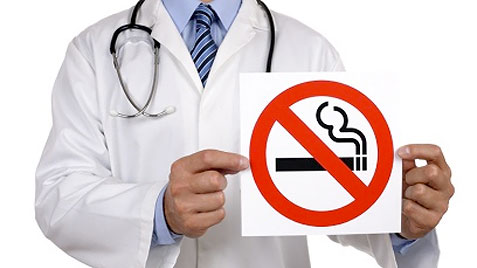
Quit Tips

Are you one of the more than 70% of smokers who want to quit? Then try following this advice.

1. Don’t smoke any cigarettes. Each cigarette you smoke damages your lungs, your blood vessels, and cells throughout your body. Even occasional smoking is harmful.

2. Write down why you want to quit. Do you want to—

    Feel in control of your life?
    Have better health?
    Set a good example for your children?
    Protect your family from breathing other people’s smoke?

Really wanting to quit smoking is very important to how much success you will have in quitting.

3. Know that it will take commitment and effort to quit smoking. Nearly all smokers have some feelings of nicotine withdrawal when they try to quit. Nicotine is addictive.a Knowing this will help you deal with withdrawal symptoms that can occur, such as bad moods and really wanting to smoke.

There are many ways smokers quit, including using nicotine replacement products (gum and patches) or FDA-approved, non-nicotine cessation medications. But there is no easy way. For most people, the worst of the symptoms only last a few days to a couple weeks.a Take quitting one day at a time, even one minute at a time—whatever you need to succeed.

4. Get help if you want it. Smokers can receive free resources and assistance to help them quit by calling 1-800-QUIT-NOW, or by visiting smokefree.gov Exit Notification, SmokefreeWomen Exit Notification, SfT (Smokefree Teen) Exit Notification, or smokefree.gov (en Español) Exit Notification. Your doctor or dentist is also a good source of help and support.

Concerned about weight gain? It's a common concern, but not everyone gains weight when they stop smoking.b Learn ways to help you control your weight Exit Notification as you quit smoking.

5. Remember this good news! More than half of all adult smokers have quit, and you can, too.c Millions of people have learned to face life without a cigarette. Quitting smoking is the best step you can take to help stay healthy.

Sources:

a. National Cancer Institute. How To Handle Withdrawal Symptoms and Triggers When You Decide To Quit Smoking. Exit NotificationOctober 2010 [accessed 2012 May 10].


b. National Institutes of Health. You Can Control Your Weight as You Quit Smoking. Exit NotificationFebruary 2010 [accessed 2012 June 13].


c. Centers for Disease Control and Prevention. Quitting Smoking Among Adults—United States, 2001–2010. Morbidity and Mortality Weekly Report [serial online] 2011;60(44):1513–9 [accessed 2012 May 10].

Sunday, March 17, 2013

Phones, Texting May Be as Dangerous as Alcohol for Drivers

Credit: www3.pcmag.com


Using a handsfree kit or sending text messages behind the wheel driving is as dangerous as being being legally drunk.

Scientists from the Australian universities of Wollongong, Victoria, Swinburne of Technology, the Institute for breathing and sleep and the University of Barcelona have measured the reaction capacity behind the wheel of healthy volunteers who participated in a driving simulation test lasting two days, each a week apart.

The study included 12 university students who took two driving-simulation tests -- once after consuming alcohol and once while using headphones and a microphone to simulate a hands-free system. People who were habitual drinkers or had never consumed alcohol were not included in the study.

The participants, who had driving licenses, had to maintain their vehicle's position in the center of the left lane at a speed of between 60 and 80 kilometres per hour, and brake every time a truck appeared.

Texting while Driving is Dangerous

The researchers found that when having a phone conversation that required a lot of attention or when answering a text message, the participants' levels of distraction were equal to the effects of having a blood alcohol concentration (BAC) that was above the legal level in both countries (0.5 grams per liter).

Handsfree just as Bad

"Our results suggest that the use of hands-free devices could also put drivers at risk," Leung Shuk Man said. "Although they should be allowed, they require more research to determine how they should be regulated and, of course, the thorough knowledge that national authorities should have regarding their pros and cons," concludes study co-author Sumie Leung Shuk Man, a researcher at the University of Barcelona.


###


The above story is based on the March 13, 2013 news release by  Spanish Foundation for Science and Technology (FECYT)


The research has been published in Traffic Injury Prevention, the official journal of the Association for the Advancement of Automotive Medicine (AAAM), International Council on Alcohol, Drugs and Traffic Safety (ICADTS), the International Research Council on Biomechanics of Injury (IRCOBI) and the International Traffic Medicine Association (ITMA):

Leung S, Croft RJ, Jackson ML, Howard ME, McKenzie RJ. A comparison of the effect of mobile phone use and alcohol consumption on driving simulation performance. Traffic Inj Prev. 2012;13(6):566-74. doi: 10.1080/15389588.2012.683118.

More information

The U.S. National Highway Traffic Safety Administration has more about distracted driving.